
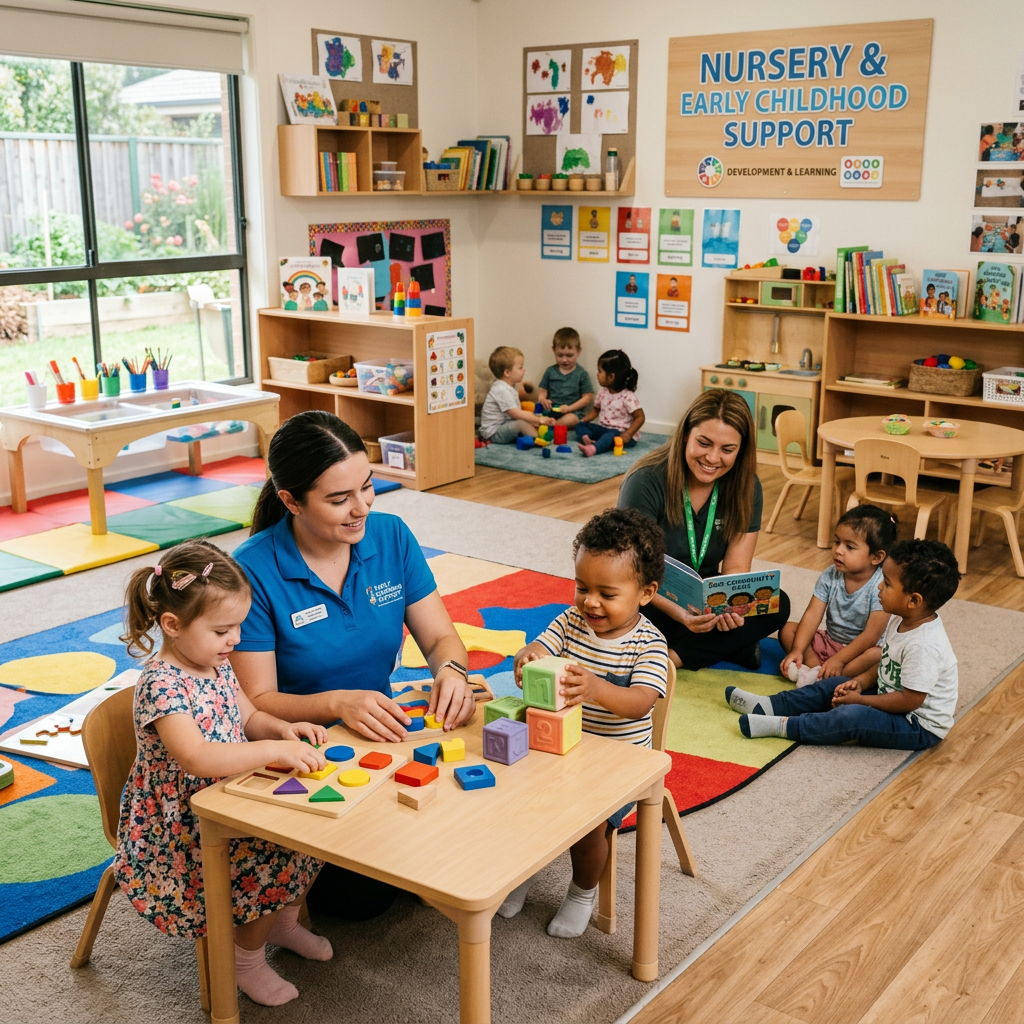
Course Code: ECS-107
Target Audience: Nanny Personnel, Child-Minders, Nursery Assistants, and Early Childhood Support Staff
Course Duration: 20 Hours (3 Days Intensive or 5 Modules)
Instructional Method: 35% Child Development & Safety Theory / 65% Practical Demonstration, Pediatric First Aid Drills & Meal Preparation Workshops
Module Overview
This specialized training module equips childcare providers with essential skills in early child development, home hazard proofing, pediatric health and nutrition, emergency first aid, and positive behavior management. Trainees will learn to provide safe, nurturing, and developmentally appropriate care for infants, toddlers, and young children in residential, nursery, and preschool settings.
Module Breakdown
Section 1: Child Development Milestones & Daily Routine Management
- Developmental Stages (Ages 0 to 6 Years):
- Infants (0–12 Months): Motor milestones (head control, rolling, sitting, crawling), sensory engagement, and attachment bonding.
- Toddlers (1–3 Years): Walking confidence, language acquisition, fine motor skills, and independence exploration.
- Preschoolers (3–6 Years): Social interactions, emotional regulation, structured play, and early cognitive skills.
- Designing Structured Daily Schedules: Balancing active play, quiet time, outdoor activities, learning moments, and age-appropriate nap schedules.
- Infant Sleep Safety (SIDS Prevention): Following Safe Sleep Guidelines: placing infants on their backs on firm, flat mattresses with no loose blankets, pillows, bumper pads, or soft toys in the crib.
[ Back-to-Sleep Position ] ──► [ Firm, Fitted Mattress ] ──► [ Clear Crib (No Pillows/Toys) ] ──► [ Monitored Room Temp ]
Section 2: Child Safety, Home Hazard-Proofing & Supervision
- Active Supervision Principles: Maintaining direct line-of-sight supervision, eliminating “blind spots” during play, and managing multi-child environments safely.
- Home & Nursery Hazard-Proofing:
- Securing heavy furniture, TVs, and bookshelves to walls using anti-tip straps.
- Installing safety gates at stairways, outlet covers, cabinet safety locks, and window guards.
- Storing household cleaning chemicals, medications, and sharp objects strictly out of reach in locked cabinets.
- Toy & Play Area Safety: Checking toys for choking hazards (using a small-parts test cylinder), sharp edges, loose batteries, or damaged parts before use.
Section 3: Pediatric First Aid, CPR & Emergency Readiness
- Pediatric CPR & Choking Management (Infants vs. Children):
- Infant Choking (< 1 Year): Executing 5 back blows followed by 5 chest thrusts while supporting the head/neck.
- Child Choking (> 1 Year): Performing abdominal thrusts (Heimlich maneuver) until the airway is cleared.
- Pediatric CPR: Compression-to-ventilation ratios and depth controls tailored for infants (2 fingers / 2-thumb technique) versus children (1 or 2 hands).
- Common Childhood Emergency Response:
- Managing high fevers, febrile seizures, severe allergic reactions (EpiPen administration basics), asthma attacks, and accidental poisonings.
- Treating minor injuries: cuts, scrapes, minor burns (cooling with tepid water), and head bumps (monitoring for concussion signs).
[ Infant Choking Identified ] ──► [ Support Head/Neck Face-Down ] ──► [ 5 Firm Back Blows ] │[ Check Airway & Repeat ] ◄── [ Turn Face-Up & 5 Chest Thrusts ] ◄───────────┘
Section 4: Pediatric Nutrition, Hygiene & Care Hygiene
- Age-Appropriate Nutrition & Meal Preparation:
- Infants: Formula preparation, sterile bottle hygiene, breast milk storage guidelines, and introducing solid foods (purees to finger foods).
- Toddlers & Preschoolers: Preparing balanced, nutrient-dense meals and snacks while avoiding high-choking-risk foods (e.g., whole grapes, hot dogs, hard candies—must be cut lengthwise).
- Diapering & Hygiene Protocols:
- Step-by-step hygienic diaper changing workflow (wiping front-to-back, diaper barrier cream application, sanitizing changing pads).
- Supporting successful, stress-free toilet training routines for toddlers.
- Teaching proper handwashing habits through interactive songs and routines.
Section 5: Positive Guidance, Emotional Regulation & Parent Communication
- Managing Behavior & Emotional Outbursts:
- Understanding the root causes of toddler tantrums (fatigue, hunger, frustration, communication barriers).
- Applying positive redirection, calm co-regulation techniques, and setting clear, gentle boundaries (avoiding physical punishment or shaming).
- Daily Communication & Handover Reporting:
- Maintaining a detailed Daily Child Care Log (tracking nap durations, meal quantities, diaper/toilet frequency, activities, and mood updates).
- Communicating professionally with parents regarding child development highlights, routines, or minor behavioral concerns.
Practical Competency Assessment Sheet
Student Name: ___________________________
Date: _______________
Assessor: ___________________________
| Evaluation Criteria | Target Metric / Requirement | Pass | Fail |
| Infant Choking Response Drill | Demonstrates correct hand positioning and sequencing for 5 back blows and 5 chest thrusts on an infant manikin. | □ | □ |
| Safe Sleep Setup | Arranges an infant crib setting fully compliant with SIDS prevention standards (flat mattress, back positioning, no soft items). | □ | □ |
| Choking Hazard Meal Prep | Correctly cuts high-risk food items (e.g., grapes, cherry tomatoes, hot dogs) into safe, age-appropriate sizes. | □ | □ |
| Hygienic Diaper Change | Executes full diapering workflow, including wipe technique (front-to-back), surface sanitization, and proper hand hygiene. | □ | □ |
| Hazard Inspection Drill | Identifies and remedies 5 intentional home/nursery hazards in a simulated play environment within 3 minutes. | □ | □ |
| Parent Handover Simulation | Delivers a clear, structured daily report to a parent role-player covering meals, sleep, activities, and behavioral updates. | □ | □ |