
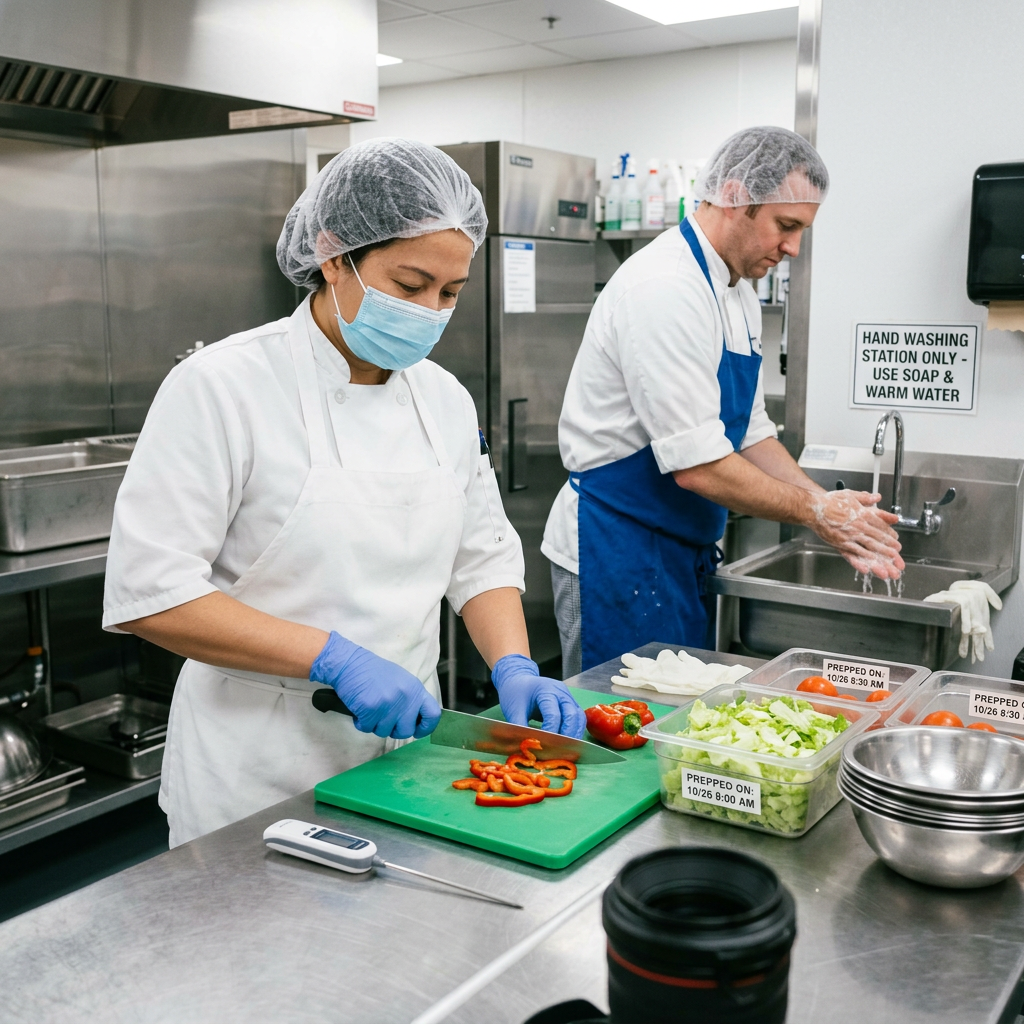
Food Safety & Hygiene (HACCP Level 1 & 2)
Course Code: FSH-104
Target Audience: Kitchen Stewards, Food Handlers, Line Cooks, Chefs, Catering Staff, and Food Service Supervisors
Course Duration: 16 Hours (2 Days Intensive or 4 Modules)
Instructional Method: 40% Theory & Regulatory Compliance / 60% Practical Kitchen Audits, Temperature Logging & HACCP Planning
Module Overview
This training module provides food service personnel with essential foundational knowledge (Level 1) and operational hazard management skills (Level 2) necessary to prevent foodborne illness, ensure regulatory compliance, and maintain strict hygiene standards in commercial kitchens, hotel dining facilities, and catering operations.
Module Breakdown
Section 1: Introduction to Food Safety & Foodborne Hazards (Level 1)
- Importance of Food Hygiene: Health impacts, legal obligations, business reputation, and economic costs of foodborne outbreaks.
- Microbiological Hazards:
- Common foodborne pathogens (Salmonella, E. coli, Listeria monocytogenes, Staphylococcus aureus, Clostridium perfringens).
- Conditions for bacterial growth (FAT TOM: Food, Acidity, Time, Temperature, Oxygen, Moisture).
- Physical, Chemical & Allergen Hazards:
- Physical: Glass, metal fragments, hair, pest droppings, packaging debris.
- Chemical: Cleaning chemical residues, pesticides, improper container leaching.
- Allergens: Managing the major food allergens (peanuts, tree nuts, dairy, eggs, wheat, soy, fish, shellfish, sesame) to avoid cross-contact.
Section 2: Personal Hygiene, Handwashing & Health Monitoring (Level 1)
- Hand Hygiene Protocols: Correct 6-step handwashing technique, required washing frequency (after handling raw food, touching face/hair, waste disposal, or taking breaks).
- Protective Clothing & Grooming: Clean chef coats/aprons, hairnets, beard snoods, closed-toe non-slip shoes, and glove usage standards (changing gloves between tasks).
- Staff Health Reporting: Mandatory reporting of illness symptoms (vomiting, diarrhea, fever, jaundice, infected skin lesions) and exclusion periods from food handling areas.
[ Wet Hands & Apply Soap ] ──► [ Rub Palms, Backs & Between Fingers (20s) ] ──► [ Rinse & Dry with Single-Use Paper ] │[ Change Gloves / Resume Tasks ] ◄── [ Avoid Touching Faucets/Handles Directly ] ◄─────────┘
Section 3: Safe Food Handling, Temperature Control & Storage (Level 2)
- The Temperature Danger Zone: Maintaining food outside the critical range of 5°C to 60°C (41°F to 140°F) where bacteria multiply rapidly.
- Critical Temperature Thresholds:
- Cold Storage / Refrigeration: ≤ 4°C (40°F)
- Freezer Storage: ≤ -18°C (0°F)
- Minimum Internal Cooking Temp (Poultry/Minced Meat): ≥ 75°C (165°F)
- Hot Holding: ≥0°C (140°F)
- Reheating: Rapidly reach ≥ 75°C (165°F) within 2 hours (reheat once only).
- Cross-Contamination Prevention:
- Color-coded cutting board system (Red: Raw Meat, Blue: Raw Fish, Yellow: Cooked Meat, Green: Produce, White: Bakery/Dairy).
- Proper refrigerator storage hierarchy (Top: Ready-to-eat foods –> Middle: Cooked foods $\rightarrow$ Bottom: Raw meats/seafood to prevent drip contamination).
- Safe thawing methods (overnight under refrigeration, cold running water, or microwave defrosting as part of immediate cooking).
Section 4: Cleaning, Sanitation & Pest Control (Level 2)
- Cleaning vs. Disinfection: Understanding that cleaning removes visible soil/grease, while disinfection/sanitization reduces microorganism populations to safe levels.
- Two-Stage & Three-Sink Dishwashing Methods: Wash (hot soapy water) –> Rinse (clean water) $\rightarrow$ Sanitize (chemical sanitizer or high-temp water ≥ 82°C / 180°F) –> Air Dry.
- Integrated Pest Management (IPM): Identifying signs of pest infestation (rodents, cockroaches, flies), maintaining structural proofing, waste management, and working with licensed pest control operators.
Section 5: HACCP Principles & Food Safety Management (Level 2)
Overview and implementation of the 7 Principles of HACCP (Hazard Analysis Critical Control Point) in commercial kitchens:
1. Conduct Hazard Analysis ──► 2. Identify Critical Control Points (CCPs) ──► 3. Establish Critical Limits │7. Establish Record-Keeping ◄── 6. Establish Verification ◄── 5. Establish Corrective Actions ◄── 4. Establish Monitoring
- Hazard Analysis: Identifying potential biological, chemical, or physical hazards at every step of food preparation.
- Determine Critical Control Points (CCPs): Pinpointing operational steps where hazards can be prevented, eliminated, or reduced to acceptable levels (e.g., cooking stage).
- Establish Critical Limits: Defining measurable criteria for each CCP (e.g., internal cooking temperature must reach 75°C for 30 seconds).
- Establish Monitoring Procedures: Setting up routine temperature logs, probe thermometer checks, and visual inspections.
- Establish Corrective Actions: Defining immediate steps to take when a critical limit is missed (e.g., continue cooking, discard off-temp food).
- Establish Verification Procedures: Auditing logs, calibrating thermometers (ice-point and boiling-point methods), and reviewing HACCP plans periodically.
- Establish Documentation & Record-Keeping: Maintaining temperature logs, delivery inspection sheets, cleaning schedules, and supplier verification records.
Practical Competency Assessment Sheet
Student Name: ___________________________
Date: _______________
Assessor: ___________________________
| Evaluation Criteria | Target Metric / Requirement | Pass | Fail |
| Handwashing Demonstration | Executes full 6-step handwashing procedure for 20+ seconds using proper single-use towel drying. | □ | □ |
| Thermometer Calibration | Calibrates food probe thermometer accurately using ice point (0°C ± 1°C) or boiling point (100°C ± 1°C). | □ | □ |
| Cold Chain & Storage Hierarchy | Correctly arranges raw meats, cooked items, and ready-to-eat produce in a simulated commercial refrigerator. | □ | □ |
| Cutting Board Selection | Selects correct color-coded cutting boards and knives for 3 distinct raw vs. ready-to-eat food preparation tasks. | □ | □ |
| CCP Temperature Log Entry | Measures internal cooking temperature of protein and logs result accurately with appropriate corrective action if undercooked. | □ | □ |
| HACCP Problem Scenario | Identifies the correct corrective action when hot-held food falls below 60°C during service. | □ | □ |